Reading time · 5 minutes 閱讀時間 · 約5分鐘
An ancestral tablet is far more than an object bearing the names of those who have passed away. It represents the continuing connection between ancestors and descendants, preserves the identity and origins of the family, and provides a focus for remembrance, gratitude and worship.
Every ancestral tablet should therefore be approached with care. Its inscription, character count, couplets and any deities included upon it may carry meanings and responsibilities inherited through many generations.
Honouring all generations of ancestors
Hinzen recommends that the principal ancestral tablet should honour all generations of the family's ancestors, rather than commemorating only one named individual.
Respect for elders and senior generations is deeply rooted in traditional Chinese family values. Ancestral remembrance extends far beyond the relatives personally known to those living today. Most people may know the names and stories of only three or four generations before them—or perhaps five generations in families fortunate enough to have preserved detailed records. The family lineage, however, reaches much further into the past.
If worship is offered only to a more recently departed or younger-generation ancestor while earlier and more senior ancestors are omitted, the order of seniority within the ancestral lineage may not be properly recognised. From a traditional perspective, this could create disharmony or conflict among the ancestral generations.
For this reason, the family's principal ancestral space should include a general tablet representing the ancestors of every generation. Its purpose is to ensure that earlier ancestors are remembered and honoured even when their individual names are no longer known.
A separate space or tablet for an individual ancestor may still be possible where there is an appropriate family or ceremonial reason. However, it should exist alongside a general tablet for all generations of ancestors, rather than replacing it.
What is normally written on an ancestral tablet?
The principal inscription will generally identify the family surname and the ancestral line being honoured. It may also include the family's ancestral place or place of origin, together with respectful titles appropriate to the family.
Including the ancestral place is not merely a geographical detail. For Chinese families living in the United Kingdom and Europe, it preserves the memory of where the family came from and helps later generations understand their roots.
The precise wording and arrangement will depend upon the family lineage, regional customs, religious tradition and the purpose of the tablet. There is no single inscription suitable for every household.
The importance of the character count
In traditional practice, the number of characters in the principal inscription is important. The characters are counted according to the repeating cycle:
生 · 老 · 病 · 死 · 苦
These five characters represent birth, ageing, illness, death and suffering. The count should return to and finish on 生, representing life, continuation and the flourishing of future generations.
When counted from the first character as 生, totals such as 1, 6, 11, 16 and 21 return to 生. Families should not rely upon this numerical pattern alone. The selection of respectful titles, the arrangement of the ancestral identity and the determination of which characters form part of the count all require knowledge and care.
The wording should not be selected casually or copied from another family's tablet. Families are advised to consult an experienced minister—such as a Taoist priest or Buddhist religious practitioner—to determine an inscription appropriate to their lineage, beliefs and circumstances.
The couplets on either side
An ancestral tablet may have a poetic couplet written on either side of the principal inscription. These corresponding lines may express gratitude for ancestral virtue, remembrance of the family's origins, continuation of the lineage, or hopes for harmony and blessings among descendants.
The wording can differ considerably. Some couplets are connected with the family surname or ancestral place, while others have been passed down as part of the family's existing tablet design. They should not be treated merely as decorative phrases without considering their meaning. Where no established wording survives, an experienced minister can help the family choose an appropriate couplet corresponding with the central inscription.
Why are deities sometimes included?
Some ancestral tablets include the names or sacred positions of particular deities alongside the family ancestors. To someone unfamiliar with the family's history, this may appear unusual. However, the practice may represent an important religious responsibility passed down through generations.
An ancestor may once have prayed to a deity during a time of illness, danger or hardship. A promise may have been made that, if protection were received or a particular wish fulfilled, the ancestor and future generations would continue worshipping that deity.
There are many other possible origins. The deity may have been connected with an ancestor's religious practice, occupation, home village, temple or personal experience of protection. Some traditions may extend so far into the past that no living family member knows precisely how they began.
Descendants should not remove a deity's name, rewrite the tablet or change an inherited arrangement casually. They should first speak with senior family members and seek guidance from an experienced minister. What appears to be a simple inscription may contain a family vow or religious obligation that should be treated respectfully.
Installing, replacing or moving a tablet
A newly prepared ancestral tablet should not simply be placed upon an altar without consideration. Its position and installation should follow the family's tradition and the religious practice being observed. Where required, a minister may conduct an appropriate ceremony before regular worship begins.
Particular care is required where an altar contains both ancestral tablets and deities. Their respective positions should not be rearranged merely for appearance or convenience.
A damaged or ageing tablet should likewise not be discarded as ordinary household waste. If it must be repaired or replaced, the family should seek advice on how the existing tablet should be respectfully handled and how the ancestral position should be transferred.
Daily incense and tea offerings
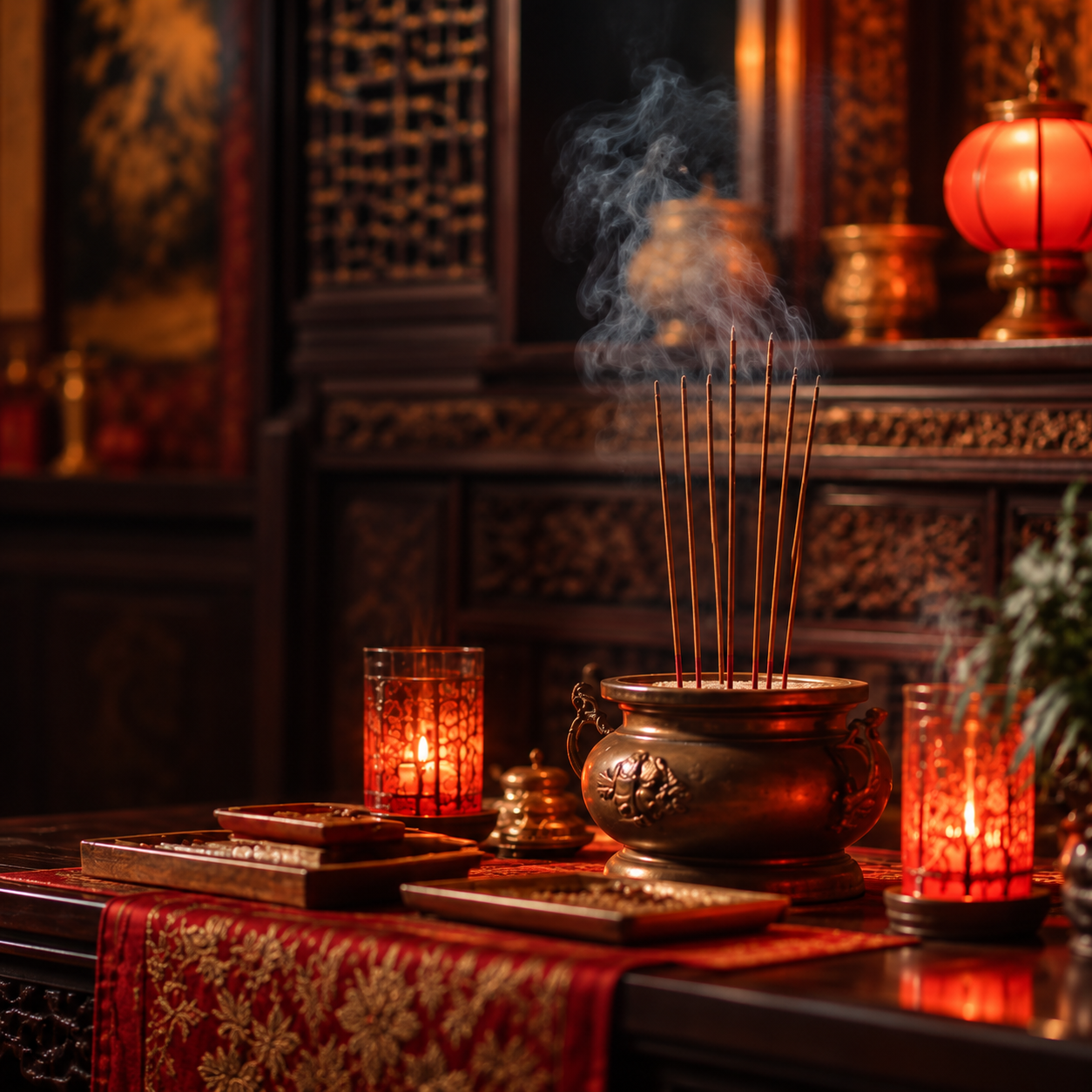
The ancestral altar should be kept clean, calm and orderly. Incense is traditionally offered twice each day: once in the morning and once in the evening. Fresh tea may also be offered daily when the family is able to do so. The act need not be extravagant; its significance lies in remembrance, sincerity and consistency.
Families living in the United Kingdom or Europe should always consider fire safety, tenancy conditions and smoke alarms. Incense should be placed in a stable holder, kept away from curtains and other flammable materials, and never left burning unattended. If incense cannot safely be burned in the home, the family may consult a minister about an appropriate alternative.
The first and fifteenth days of the lunar month
The first and fifteenth days of every lunar month—初一 and 十五—are traditional occasions for paying particular attention to the altar. Families may:
- Clean the altar and its surrounding area.
- Refresh the tea and wine.
- Replace fruit and flower offerings.
- Remove anything that is no longer fresh.
- Offer incense and respectfully pay homage.
Fruit, flowers, tea and wine should be clean and fresh. The precise type, quantity and arrangement of offerings may differ according to family custom. Additional food offerings may be prepared on festivals, death anniversaries and other important family occasions.
Keeping ancestors within the family's continuing story
Ancestral worship is not limited to asking for fortune or protection. Its foundation is remembrance, gratitude, filial respect and recognition of the sacrifices made by earlier generations.
Some families respectfully inform their ancestors of important events such as a marriage, the birth of a child, moving home or a family member beginning a new stage in life. This reflects the belief that the ancestors remain part of the family's continuing story.
The value of worship does not depend upon expensive offerings. A simple cup of fresh tea, incense offered with care and a sincere moment of remembrance can hold profound meaning.
祖先牌位與歷代祖先
祖先牌位並不只是一塊寫上先人姓名的木牌。它代表祖先與後人之間延續不斷的連繫,記載家族的身份與根源,亦是後人追思、感恩、供奉及表達孝道的重要依歸。
興善建議家中主要的祖先牌位應供奉家族歷代祖先,而不應只供奉某一位有名有姓的先人。
敬老尊長是華人傳統家庭觀念的重要根基。大部分人只能知道上溯三至四代祖先的姓名與事蹟;家族記錄保存得較完整者,或許能認識五代。然而,家族血脈實際上可以追溯至更久遠的年代。
如果只供奉較近期離世或輩分較低的先人,卻忽略更早及輩分更高的祖先,便可能未有完整尊重家族的長幼次序。從傳統觀念而言,這種安排可能在歷代祖先之間造成不和或衝突。
因此,家中主要的祖先供奉位置應設有代表歷代祖先的總牌位,讓所有先人都得到追念與尊重,包括那些姓名及事蹟已未能由後人記起的祖先。
如因家庭情況或儀式需要,另設個別先人的牌位或供奉位置亦可以處理。然而,個別牌位應與供奉歷代祖先的總牌位並存,而不應取代歷代祖先的共同位置。
牌位的寫法與字數
牌位中央的主文一般會寫上家族姓氏,以及所供奉的歷代祖先。當中亦可能包括家族的祖籍、籍貫或原鄉,並按照家族情況加上合適的尊稱。
對於移居英國及歐洲的華人家庭而言,寫上祖籍可以保存家族源流,讓後代知道自己的根源所在,不忘先人從何而來。
在傳統習俗中,牌位主文的字數十分重要。文字會按照「生、老、病、死、苦」的次序循環計算,並應再次落在「生」字之上,寓意生命延續、家族承傳及後人興旺。
若由第一個字以「生」開始計算,字數為一、六、十一、十六或二十一等,便會再次落在「生」。然而,家屬不應只依靠數字自行撰寫。尊稱的選用、祖先身份的排列,以及哪些文字需要納入計算,都必須慎重處理。
祖先牌位的文字不宜隨意決定,亦不應直接抄寫其他家庭的牌位。家屬應請教有經驗的宗教師傅,例如道長或法師,按照家族源流、信仰及實際情況,選定合適的寫法。
牌位兩旁的對聯
祖先牌位的主文兩旁,可能會寫上一副對聯。對聯可以表達後人對祖德的感恩、對家族根源的追念、血脈延續的願望,以及祈求後代和睦、福澤綿長。
不同家族所用的對聯可以有很大差異。有些與家族姓氏或祖籍有關,有些則沿用歷代相傳的舊有格式。因此,對聯不應只被視為裝飾文字,而忽略其背後的意思。
為何有些家族牌位會包括神明?
部分家族牌位除了供奉祖先,也可能同時列有某位神明的名號或神位。這種安排有時代表着一項歷代相傳的重要宗教責任。
昔日某位祖先可能曾在患病、遇險或面對困境時向神明祈求,並許下承諾:若得到庇佑或願望得以實現,自己及後代便會繼續供奉該位神明。
神明的供奉亦可能與祖先的宗教修持、行業、家鄉、廟宇,或曾經得到庇佑的經歷有關。有些傳統流傳年代久遠,現今家族成員可能已無法確定其最初由來。
因此,後人不應隨意刪去神明名號、重寫牌位或改動歷代相傳的供奉方式。應先向家中長輩了解家族歷史,並請教有經驗的宗教師傅。看似簡單的文字背後,可能包含家族先人所立的誓願,或需要尊重並繼續承擔的宗教責任。
安奉、更換或移動牌位
新造的祖先牌位不宜未經考慮便直接放上神枱。牌位的位置及安奉方法,應配合家族傳統及所依循的宗教禮法。如有需要,可由宗教師傅進行合適的安奉儀式,然後才開始日常供奉。
如果神枱同時供奉祖先與神明,更應注意彼此的位置,不宜只為美觀或方便而自行改動。破損或老化的牌位亦不應當作普通家居廢物棄置。如需修復或更換,家屬應先請教適當的處理方法。
每日上香與奉茶
祖先神枱應保持清潔、安靜及整齊。傳統上每日上香兩次,早上一次,晚上一次。家人能力許可的話,亦可每日奉上新鮮茶水。供奉不必鋪張,最重要的是追思祖先,以及保持真誠和恆心。
居住在英國或歐洲的家庭,亦必須顧及消防安全、租住條款及煙霧警報器。香爐應放置穩妥,遠離窗簾及其他易燃物品,燃點香火時切勿無人看管。如果家中環境不適宜燃點香火,可請教宗教師傅,尋求合適的替代方式。
農曆初一、十五的供奉
每月農曆初一及十五,是傳統上整理神枱及加意供奉的重要日子。家人可清潔神枱及附近地方、更換茶與酒、換上新鮮水果及鮮花、移走已不新鮮的供品,並上香向祖先恭敬行禮。
供品的種類、數量及排列方式,可以按照各自的家族傳統處理。到了傳統節日、先人忌辰或其他重要日子,家人亦可準備較豐富的祭品。
尊重家族相傳的習俗
供奉祖先並不只是祈求財運或庇佑。其根本意義,在於追思、感恩、盡孝,以及記念歷代先人為家族所付出的一切。
不同家庭、地區及宗教傳統,都可能有不同的供奉方式。後人應先了解及尊重自己家族相傳的習俗,不應認為所有祖先神位都必須採用完全相同的形式。
歷代相傳的祖先牌位,可能保存着未能從表面看出的家族歷史、宗教誓願及承傳責任,因此不宜隨意重新上漆、改寫、移動或棄置。
在設立新牌位或對原有牌位作出重大改動之前,家屬應先請教家中長輩及有經驗的宗教師傅。透過適當指引,既可確保歷代祖先都得到恭敬供奉,亦能讓家族的宗教傳承得到尊重,延續至未來世代。